Key takeaways
- A Google ranking and an AI recommendation answer different jobs; one does not automatically create the other.
- AI answers can vary with the customer’s wording, the location, the tool and the sources available at that moment.
- Accurate local business information, clear service pages and useful evidence are sensible foundations—not guarantees.
- Check a pattern across realistic questions before deciding what to improve.
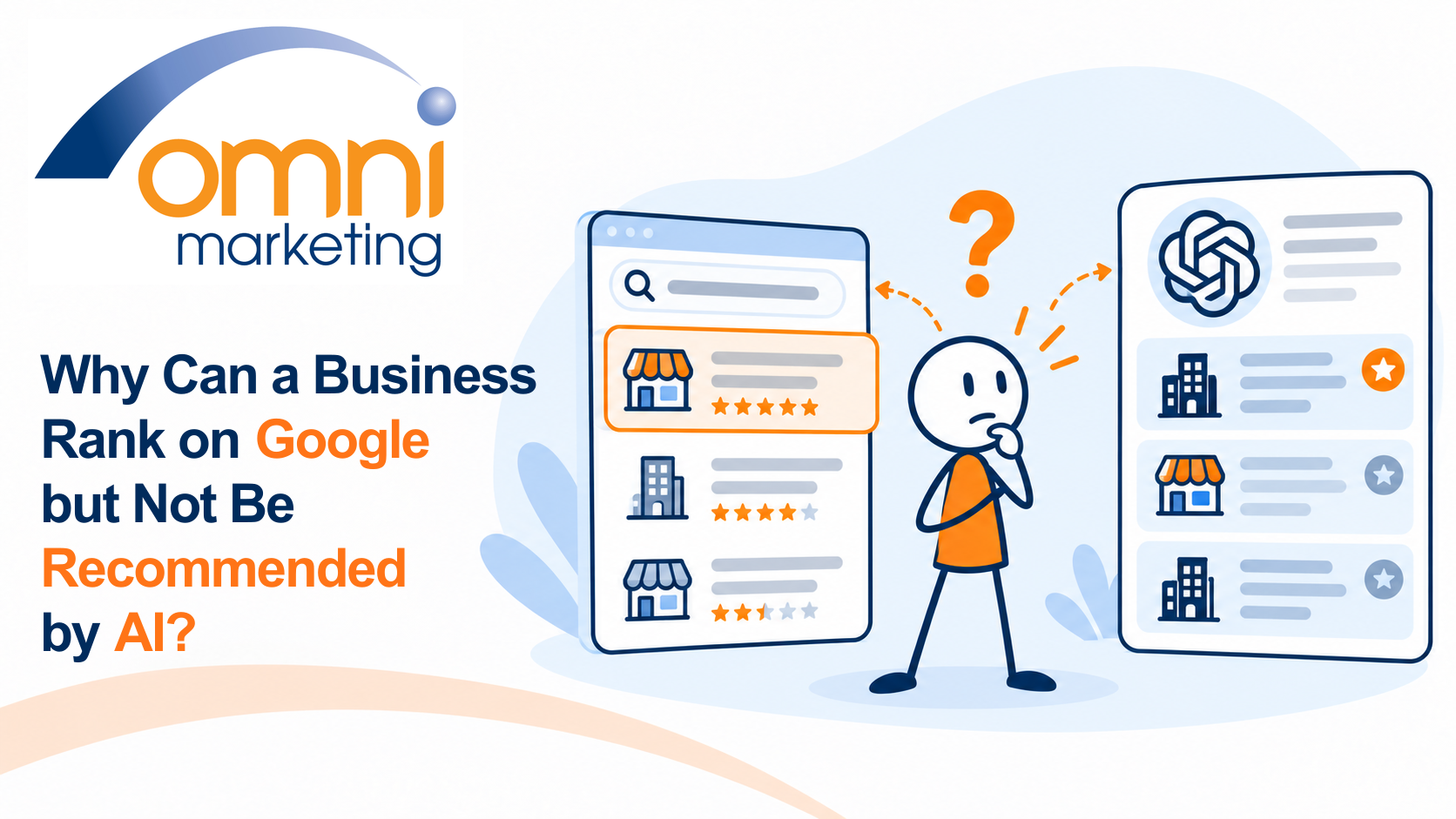
A business owner can see their company on Google and reasonably wonder why it is not named when a customer asks an AI assistant for a recommendation. It is not necessarily a sign that something is broken. The two results may be solving different versions of the customer’s problem.
Direct answer
A Google ranking does not guarantee an AI recommendation because an AI answer may weigh the wording of the question, location, source material and the assistant’s own retrieval approach. Make the business easy to understand, then test several genuine buyer questions before drawing conclusions.
Why the two results do different jobs
A search result is an invitation to visit a page. A recommendation is a much narrower judgement: which business, if any, best fits this particular question. That distinction is why a visible Google result can coexist with no AI mention.
Google’s guidance for AI features explains that its established Search eligibility and SEO guidance still applies to AI Overviews and AI Mode. It also makes clear that there are no extra AI-only requirements and no guarantee of appearing in an AI feature. The foundation is useful; it is not a promise.
That is also why “we rank on Google” is a useful starting observation, not the end of the investigation. A page may be findable for one phrase while still leaving a potential customer—or an answering system—unclear about the service, client type or local area it covers.
Why the question and location matter
AI answers are sensitive to the question being asked. “Accountants in Swansea” is a broad discovery query. “Which Swansea accountant helps a growing limited company with management information and tax planning?” requires a more specific fit.
For local businesses, location is only one part of that fit. Google says local results are influenced by relevance, distance and prominence; complete, accurate Business Profile information can help it understand relevance. Google’s local ranking guidance is useful here because it focuses on helping customers understand a business rather than trying to manipulate a position.
Different answer engines can also use different sources and methods. A proprietary Yext comparison study found that AI platforms often returned different answers and source mixes for the same types of questions. Treat that as a prompt to test relevant platforms, not as a rule about how every answer engine works.
A useful check
Separate what you know from what you assume
Google observation
Record the exact search and page that appears. Avoid calling a single ranking a verdict on the whole site.
Buyer question
Write the complete question a real prospect would ask, including service, audience and location where relevant.
AI observation
Note the businesses and sources mentioned, the date and the tool used. One answer is only a snapshot.
Useful next action
Look for repeated information gaps before deciding whether to correct a fact, improve a page or create a new answer.
How to check the gap without guessing
Start with three to five buyer questions, not a vague request for “the best businesses”. Use the wording customers use when they are close to deciding: the problem they need solved, the kind of business they run and the town or region where it matters.
Then compare the answer with the information a prospect can verify on your own website. Does a key service have a clear page? Does it say who it is for? Does it explain the outcome, area served and sensible next step? Are the main business details consistent with the public profile a customer would see?
If the answer differs between tools, do not rush to fixate on a technical explanation. The productive question is whether the public information makes the business an obvious fit for the buyer’s question. Our guide to checking AI visibility with ten practical questions gives a structured way to record those observations.
What to improve first
Begin with the pages and facts closest to an enquiry. For most local businesses, that means accurate contact and location details, clear service descriptions, proof that helps a prospect assess the business, and answers to recurring buying questions.
That work benefits people regardless of which AI service they use. It also aligns with Google’s people-first guidance for AI features: make important content available in text, use clear internal links and make sure pages can be indexed. None of those steps guarantees a recommendation, but they reduce the avoidable uncertainty a potential customer encounters.
For assistants that search the web, access can be another sensible check. OpenAI’s crawler documentation explains that its search crawler can be allowed separately from its training crawler; being crawlable is an eligibility check, not a promise that a site will be surfaced or cited. That is a supplier or web-team question, not a shortcut to a recommendation.
Use the difference as a planning signal
The gap between a Google result and an AI recommendation can be useful because it exposes a better question: is the business’s relevance obvious to the person who needs it? Improving the answer may mean correcting a detail, strengthening a service page or publishing a genuinely helpful explanation—not chasing a magic setting.
To understand the broader relationship between the two channels, read AI visibility versus SEO. If you want to explore what an assistant may be weighing when it does choose a business, our guide to how AI chooses businesses to mention is the natural next step.