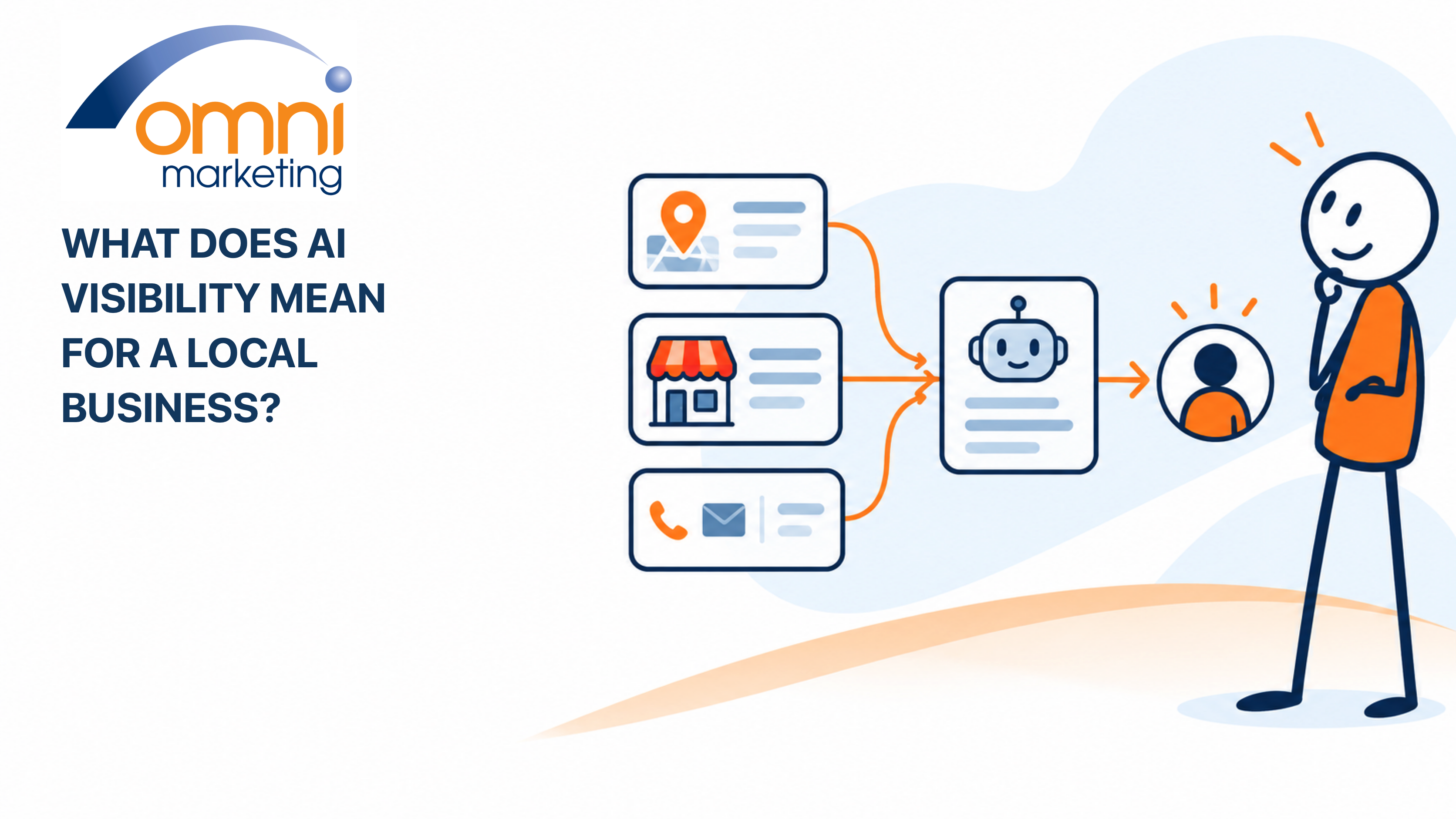
Key takeaways
- AI visibility is about what a customer can discover when they ask a detailed question—not simply whether a business is first in a search result.
- A local business can be visible through an accurate answer, a cited page, a business mention or a recommendation; these are different signals.
- Clear service information, correct local details and useful answers to buyer questions make a business easier to understand.
- No single update guarantees an AI mention or an enquiry, so use repeatable questions and record what you find.
“AI visibility” can sound like a new score that businesses either have or do not have. In practice, it is simpler and more useful than that. It is a way of checking whether someone who needs your kind of help can find accurate, trustworthy information about your business when they use tools such as Google AI features, ChatGPT or Perplexity to research a problem.
Direct answer
For a local business, AI visibility means being understandable and discoverable when a prospective customer asks an AI tool a real buying question. The practical task is to make the services, audience, location and next step easy to verify—not to chase a secret AI ranking formula.
What does AI visibility mean in plain English?
AI visibility is the extent to which a business and its information appear when an AI-powered tool helps someone research a need. The question may be broad, such as “What should I ask an accountant before forming a limited company?”, or local and specific, such as “Which Swansea accountant helps growing limited companies with management information?”
That buyer may not know a supplier’s name yet. They are trying to understand the problem and identify credible options. If an answer names your business, links to a useful page, describes your services accurately or points the reader to information you control, that is part of your visibility. ChatGPT search, for example, can use web sources when answering a question; Google describes its AI search features as another way people can explore complex questions and reach supporting pages.
The useful business question is therefore not “How do I beat the algorithm?” It is: “If a suitable customer asks a sensible question, what information about us can they find, and would it help them take the next step?” For the wider commercial context, see why AI visibility matters for business.
What AI visibility is not
AI visibility is not one universal ranking, and it is not a promise that an assistant will recommend a business. Different tools can use different sources, answer a question in different ways and respond to changes in the wording, location or context of the search. A business may be linked as a source without being recommended, or mentioned without receiving a click.
It also does not replace ordinary search fundamentals. Google’s own guidance on AI features says the normal SEO practices still apply and that there are no additional requirements for appearing in AI Overviews or AI Mode. That is useful perspective: work on the information customers need, rather than paying for a supposed shortcut.
A useful way to read the signals
Different outcomes answer different questions
- Mention
- Your business name appears. This can show awareness, but not necessarily a route for the reader to act.
- Citation or link
- A page is used as supporting material. Check whether the page gives the customer the answer they expected.
- Recommendation
- Your business is offered as an option. This is closer to a buying decision, but is still not a guaranteed enquiry.
- Accurate description
- The tool explains what you do, where you work and who you help correctly. This matters even when it does not name you first.
Our guide to AI mentions, citations and recommendations explains these distinctions in more detail. Keeping them separate stops a one-off result from being mistaken for proof of a wider trend.
What can a local customer actually see?
When a customer researches a local service, an AI answer may draw on web pages, local information and sources it judges relevant to the question. The customer might see a brief explanation, links to supporting pages, several named businesses or a mixture of all three. The exact format varies, so the important thing is whether your public information helps the customer understand the offer.
For an accountancy firm, that may mean a service page that plainly explains which businesses it helps, the work it handles and how a prospective client can make contact. For a trades or professional-services business, it may mean clear coverage areas, current contact details and useful answers to common pre-purchase questions. Google’s Business Profile guidance similarly stresses complete and accurate information so customers can understand what a business does, where it is and when it is open.
This is not an instruction to copy the same sentence everywhere. It is an instruction to make the important facts agree. A customer should not find one service on the website, a different coverage area on a profile and an outdated telephone number in a directory.
Where should a local business start?
Start with three to five questions that a genuine potential customer would ask before getting in touch. Include the service, the type of customer and the town or region where that matters. Ask them in the tools your audience is likely to use, then record the wording, date, answer, businesses named and sources linked.
Next, compare what you found with the information you control. Is the relevant service clear? Does the page answer the buyer’s question? Are your website, Business Profile and contact details accurate? This gives you a practical improvement list without claiming to know why one individual AI answer changed.
If you need a structured starting point, use our ten-question AI visibility self-assessment. When you find a genuine gap, our guide to turning AI visibility gaps into practical tasks explains how to decide what to update first.