Key takeaways
- Your partners already know the questions prospects ask and the answers they need.
- Capture that knowledge in a short conversation, so partners talk rather than write.
- Publish it once as a proper article on your own website, under the partner’s name.
- Then cut the article into a short video and a few social posts that link back to it.
- The partner checks facts, tone and confidentiality before anything goes out.
Most accountancy firms have plenty of expertise. It sits in partners’ heads, in client meetings and in the answers they give on the phone every week. The problem is turning it into marketing when nobody has time to write.
This guide sets out a simple way to capture what a partner knows once and use it in three places: an article, a short video and social posts. If you want to know why showing expertise matters in the first place, read how an accountancy firm can demonstrate its expertise before a prospect makes contact.
How can an accountancy firm turn partner knowledge into articles, video and social content?
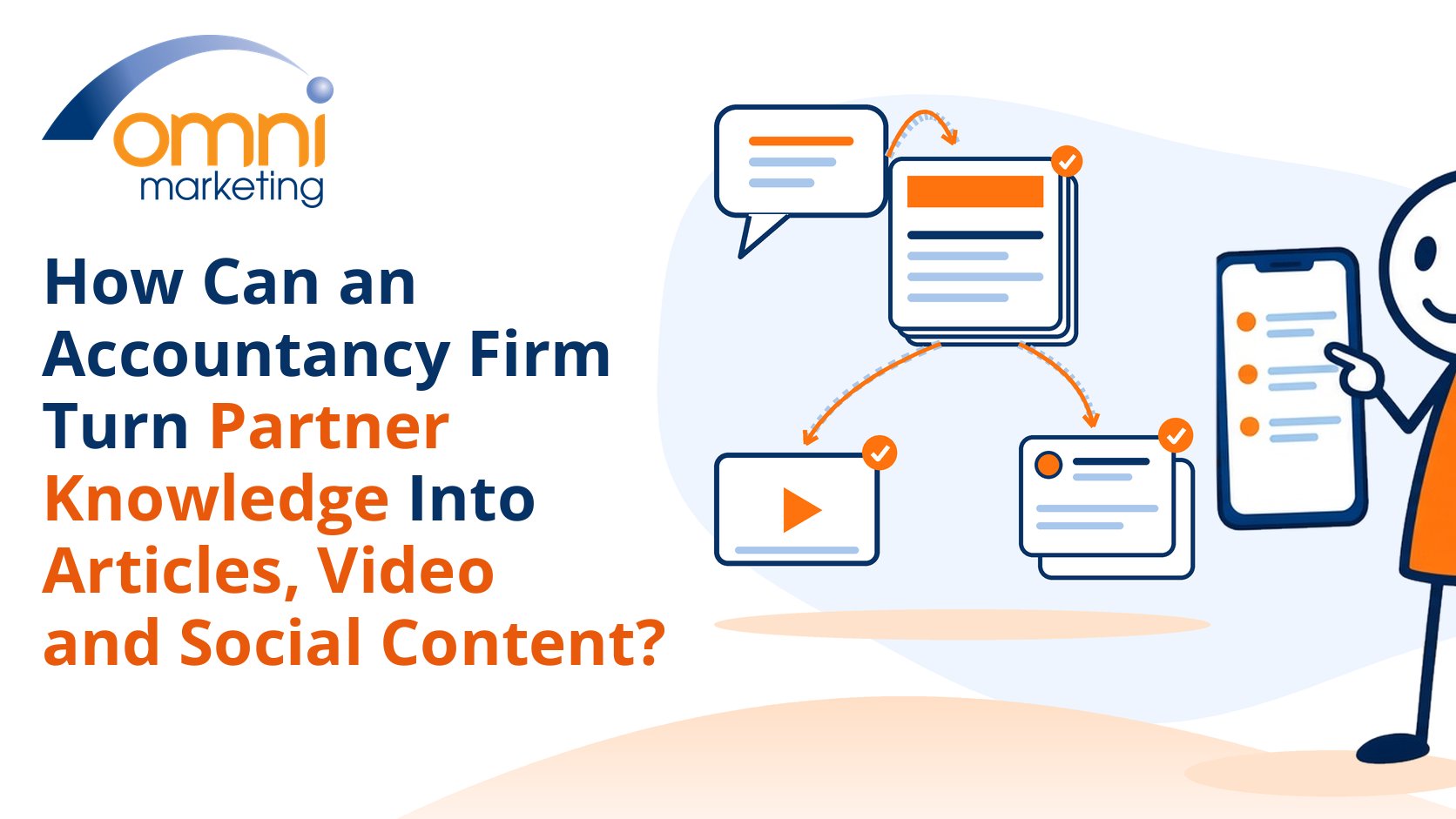
Capture one real client question in a short conversation with a partner. Turn their answer into an article on your website under their name, then cut it into a short captioned video and a few social posts that link back. The partner checks the facts and the tone before anything is published.
Watch the guide
How can an accountancy firm turn partner knowledge into articles, video and social content?
Prefer to watch? This short guide covers why partner knowledge is worth publishing, how to capture it without asking a partner to write, how one conversation becomes an article, a video and social posts, what the partner should check and how to tell it is working.
Why is partner knowledge worth turning into content?
Because it is the thing prospects are actually looking for: clear answers from someone who knows. Generic content is easy to find. A partner’s first-hand view of a problem they see every week is not.
Google’s guidance on creating helpful, reliable, people-first content asks whether content shows first-hand expertise and a depth of knowledge. It also asks whether it is written or reviewed by an expert who clearly knows the topic. Partner knowledge meets both tests in a way a rewritten summary of other people’s articles does not.
It also builds trust. ACCA’s modern marketing guidance for practices says people choose accountants they trust. It suggests showing your expertise with educational content that attracts the right prospects.
How do you capture what a partner knows without asking them to write?
Ask them to talk, not write. Most partners can explain a client problem clearly in conversation, even if a blank page puts them off.
Start with one real question that clients or prospects ask them often. Book a short conversation, in person or on a video call, and record it with their agreement. Ask what the question usually is, what the honest answer is, what people commonly get wrong and what they should do next.
Someone else then turns the recording into a draft: a marketing colleague, an assistant or an outside writer. Transcription tools can help, but the draft should keep the partner’s own examples and judgement. For help choosing topics, see our guide on what to write about to attract your ideal clients.
How does one conversation become an article, a video and social posts?
Publish the article first, then reuse it. The article is the full answer; the video and posts are shorter routes into it.
ACCA’s In Practice article The critical factors in winning new clients makes the case for this. It suggests making each piece of content work hard. A blog can become a video, a downloadable resource and bite-sized social posts that link back to your website.
The article
Put the article on your own website, with the partner’s name in the byline and a short author profile. Google’s guidance says it helps when it is clear who created a page, and when bylines lead to more information about the author.
The video
Take the single most useful point from the article and explain it in a short video, either the partner speaking to camera or a simple animated version. Add captions. YouTube’s help centre says subtitles and captions let you share videos with a larger audience, including deaf or hard-of-hearing viewers. Embed the video on the article page too, so both work together.
The social posts
Turn the article’s key points into a few short posts, each making one point and linking back to the full article. Partners can share them from their own profiles as well as the firm’s. LinkedIn’s help centre notes that members can publish articles about their expertise and insights, so a partner could also share a short summary there. For how this fits with search and LinkedIn more widely, see whether a firm should focus on SEO, LinkedIn or content marketing.
What should a partner check before anything is published?
Three things: accuracy, tone and confidentiality. The partner does not need to rewrite the draft, but they do need to sign it off.
First, the facts. Any tax or technical point should be correct and current, with the date it was written made clear. Second, the voice. It should sound like the partner, not like a generic marketing script.
Third, client confidentiality and fair claims. ICAEW’s marketing helpsheet reminds firms that claims should be substantiated and not misleading. It also notes that client testimonials need the client’s consent, because the relationship is confidential. In practice, anonymise client stories so nobody can be identified, and check your own professional body’s guidance.
A practical check
From one conversation to three formats
- Pick one real question. Choose something clients ask a partner often.
- Record a short conversation. Let the partner talk; someone else drafts.
- Publish the article first. On your website, under the partner’s name.
- Cut it down. One short captioned video and a few posts that link back.
- Get partner sign-off. Facts, tone and client confidentiality checked.
How often should a firm do this, and how does it know it is working?
Pick a pace you can keep, such as one partner conversation a month, rather than a burst that fades. A steady run of useful answers is worth more than a busy launch.
Judge it by the enquiries it helps produce, not by views or likes alone. ACCA’s guide on creating a marketing plan says your plan should line up with your business goals, and that hoping for a set number of social media followers is not what it is about. It also recommends building in a regular review.
Ask new enquiries how they found you and what they read or watched first. Over a few months, note which topics and partners come up, and whether those enquiries were a good fit. If you are still deciding whether content is worth the effort, read does content marketing work for UK accountancy firms.
The same articles also help your firm show up clearly when people use AI tools to look for an accountant. Our guide to what AI visibility means for a local business explains why, and our AI visibility hub for local businesses collects the rest. To see where your firm stands today, request a free AI Visibility Report.