Key takeaways
- Start with three to five specific questions a potential customer would genuinely ask.
- Record mentions, source citations and recommendations separately—they mean different things.
- Check whether the answer describes your services, place and next step accurately.
- Use the pattern to choose an improvement, rather than trying to chase a universal AI score.
An AI visibility check is most useful when it behaves like a practical customer-journey review. The point is not to see whether your name appears once. It is to understand whether a prospective customer can find, understand and trust your business when they ask a real question.
Direct answer
Measure a repeatable set of buyer questions; whether your business is mentioned, cited or recommended; whether the details are accurate; and whether the answer gives a customer a sensible route to act. Compare the pattern over time, then make one useful improvement at a time.
Watch the guide
What should a local business measure in an AI visibility check?
Prefer to watch? This short guide shows how to turn buyer questions, answer types and accurate local information into a repeatable check.
What should the check measure?
A useful check measures whether a buyer receives a helpful answer, not whether a platform awards a score. Google says that its normal Search fundamentals remain relevant to AI features: pages need to be eligible for Search, but appearing is not guaranteed. That makes a small, repeatable evidence log more valuable than a one-off result.
A simple measurement frame
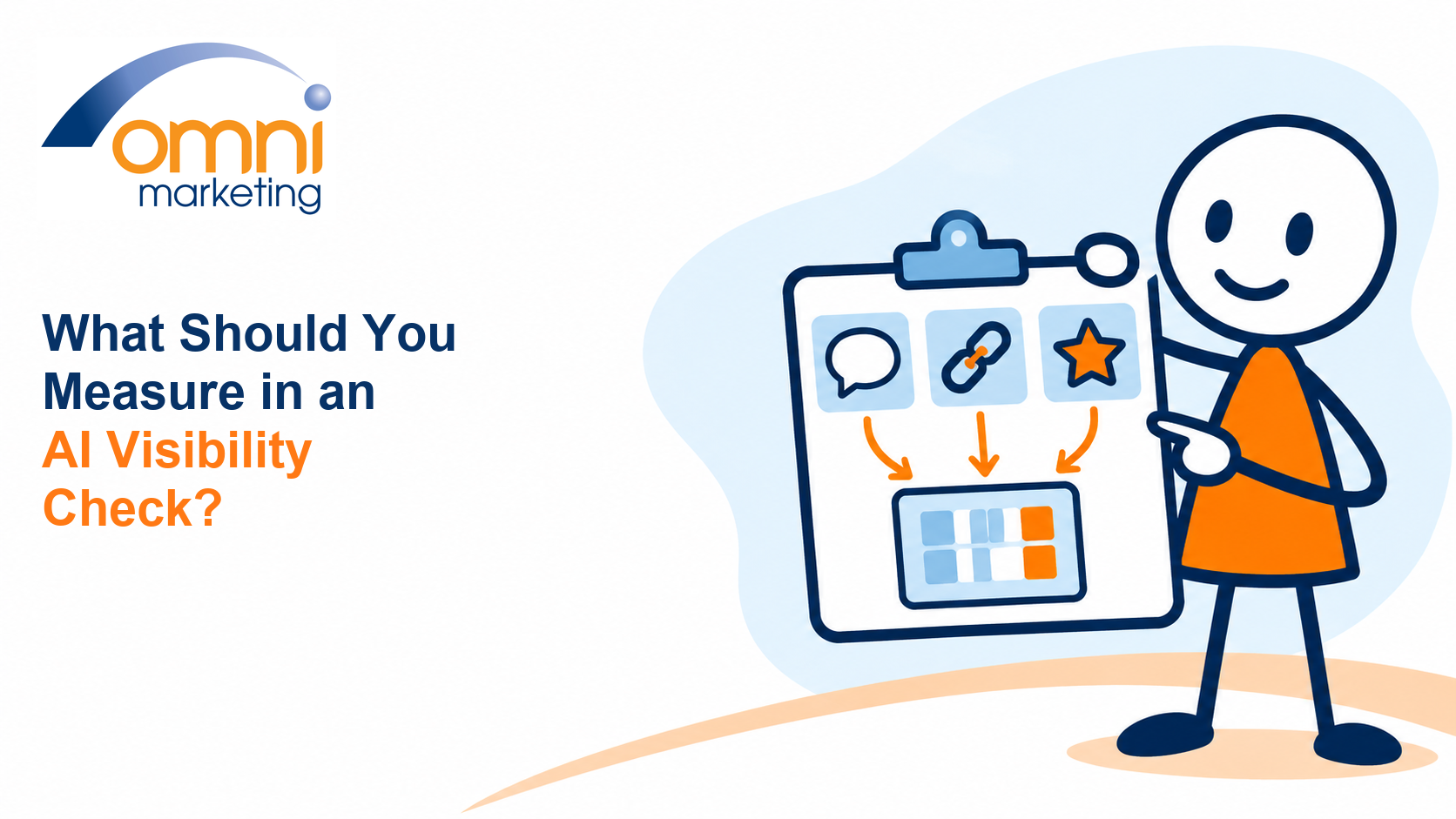
Test, read, check, improve
- Test. Ask a genuine buyer question.
- Read. Separate a mention, a source citation and a recommendation.
- Check. Compare the answer with your actual services and local information.
- Improve. Choose one clear next action from the evidence.
This approach also keeps expectations honest. AI results may vary by wording, location, time and the information currently available to the system. The aim is to reveal where a buyer could become confused or lose confidence—not to promise a fixed placement.
Which buyer questions should you test?
Use questions that resemble the moment a good-fit customer starts looking for help. Include the service, customer type and town or region when they matter. For an accountant, “Which Swansea accountant helps growing limited companies with management information?” is more useful than “Who is the best accountant?”
Choose three to five questions and keep them stable for a while. ChatGPT search can use web search and, for local results, location information; OpenAI’s guidance also notes that adding a city, neighbourhood or postcode can improve a local result. That makes the location wording part of the check, not an afterthought.
How should you read the answer?
Do not collapse every appearance into a single “yes” or “no.” A mention means that your name appears. A citation means a page is being used as evidence. A recommendation means the answer presents your business as a suitable option for the customer’s need. Each tells you something different about visibility and trust.
For a closer look at the distinction, read whether AI mentions, citations and recommendations are the same thing. If you already see your business appearing, learn how to tell whether it is really being recommended before you draw a commercial conclusion.
Which business facts need checking?
Check the practical information a customer would use to decide whether you are relevant: what you do, who you help, where you work, how to contact you and what the next step looks like. If an answer gets those basics wrong, a customer can be lost even when the business name appears.
Google’s local ranking guidance says that complete and accurate Business Profile information helps it match a business with relevant searches, and describes relevance, distance and prominence as key local-result factors. Keep the facts on your website and Business Profile aligned; this is clarity for customers, not a guarantee of an AI recommendation.
How should you record the results?
A straightforward spreadsheet is enough. Capture the exact question, date, platform, any place wording, the answer’s description of your business, the other businesses returned and the source links it uses. If it is a recommendation, record the reason the answer gives.
Then look for the pattern. Are you absent from the questions that matter most? Is your service being described too broadly? Is another page repeatedly acting as the source? Those observations are more useful than a score because they point to a specific content, local-information or conversion improvement.
What should happen after the first check?
Choose one next action. You may need a clearer service page, a more complete local profile, stronger evidence that explains who you help or a better route from the page to an enquiry. Repeat the same questions after a meaningful change and compare what genuinely changed.
For a longer-term method, see how to measure AI visibility improvement over time and what good AI visibility looks like for a local business. If you want an independent starting point, a report can help turn the check into a prioritised conversation.