Key takeaways
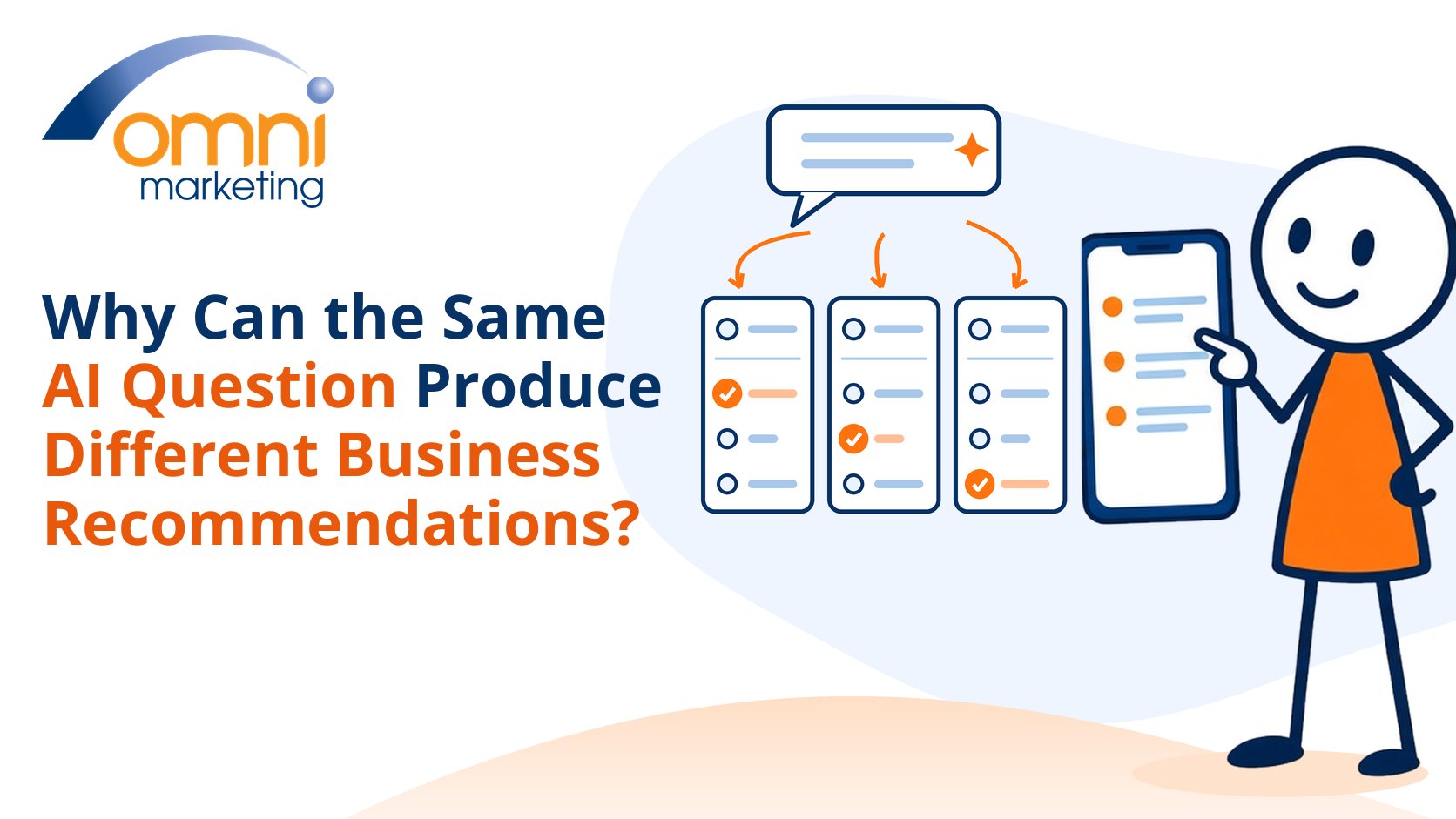
- The same AI question can produce different business recommendations, even when the wording and the person asking stay the same.
- AI tools write each answer afresh. They do not pull up one stored answer.
- Many AI search tools also run their own searches each time, so they can find different pages and name different businesses.
- Time matters. New content appears, and systems change, so an answer today may not match the answer next week.
- One answer is a snapshot, not a ranking. Repeat the check, record the conditions and look for patterns.
- You cannot control the variation. You can keep your public business facts clear and consistent.
If you run an accountancy practice or an established local business, you may have asked ChatGPT or Google who it recommends for your service. Then you asked again, perhaps the next day, and saw a different list. That can be unsettling, especially if you were named the first time and missing the second.
Nothing is necessarily broken. AI visibility is about whether your business is found, understood and trusted when customers use AI to look for help. If that idea is new, start with what AI visibility actually means for a local business. This article looks at one practical question within it: why the answer moves when the question does not.
Direct answer
AI tools generate each answer afresh rather than looking up one fixed reply. Many also run their own searches each time, so they can find different pages and name different businesses. Treat any single answer as a snapshot, not a ranking. Repeat the same question, record the conditions and judge the pattern.
Watch the guide
Why can the same AI question produce different business recommendations?
Prefer to watch? This short guide explains why the same AI question can name different businesses, and how to check your AI visibility fairly when answers vary.
Why does AI give different answers to the same question?
Because the answer is written, not looked up. A search engine can return a stored list of pages. An AI assistant builds its reply as it goes, choosing words and ordering points each time it responds.
OpenAI is open about this in its developer documentation. Its guide to making outputs reproducible says its models are non-deterministic by default, so outputs may differ from request to request. Even with special settings, it says consistency is not guaranteed.
For a business owner, the plain-English version is simple. Two replies to the same question can be worded differently, put things in a different order and sometimes mention different names. That is how the technology normally behaves.
Customers can also differ from you. That is a separate point, covered in whether AI search results are the same for every customer. Here the person, place and wording stay the same, and the answer still moves.
Why can the businesses named change, not just the wording?
Because many AI tools search the web as part of answering, and the search itself can change. The wording of a reply is one source of variation. The pages the tool finds are another, and they decide which businesses are available to name.
Google explains that its AI features may use a technique it calls "query fan-out". Its Search Central guidance on AI features and your website says this means issuing multiple related searches across subtopics and data sources. It also says AI Mode and AI Overviews may use different models and techniques, so the responses and links they show will vary.
ChatGPT works in a similar way. OpenAI's help page on searching the web with ChatGPT says it typically rewrites your question into one or more targeted searches. It may then send further, more specific searches after reviewing the first results.
Our reading of this is straightforward, though neither company measures it for local businesses. If the searches the tool runs differ from one ask to the next, the pages it finds can differ. Different pages can mean a different shortlist.
Time plays a part as well. Google's help page on why search results differ says new content is added soon after it is published. It also says changes to its ranking systems roll out gradually. Even people searching minutes apart can see variations.
Is a different answer a sign that something is wrong?
Not by itself. Variation is a normal feature of how AI answers are produced. A different answer does not prove that your business has dropped out, and a flattering answer does not prove that it has been secured.
It does mean one answer cannot be your verdict. It is a clue, and a useful one. If AI describes your firm accurately, that is encouraging. If it leaves you out once, note it and ask again before drawing a conclusion.
There is also no fixed rule that guarantees a mention. We explain this in why AI recommends some local businesses and ignores others. And it helps to be clear about what you are counting, because being recommended is different from being named. Our guide on how to tell whether AI is really recommending your business sets out the difference.
How should you check AI visibility when answers vary?
Ask the same question more than once, and write down what you see each time. The aim is to find the pattern, not to catch a single lucky or unlucky answer.
Keep the wording identical, so you are testing the tool and not your phrasing. Record the date, the tool, the town you included and whether you were signed in. Our guide to what to record in an AI visibility check covers the details worth capturing.
Then repeat the check on different days. Our article on how to measure AI visibility over time without cherry-picking answers makes the key point: do not refresh until you find a flattering answer. If you would rather have a consistent outside view, a free AI Visibility Report gives you a dated snapshot of how your business appears.
OpenAI also notes that search results and citations can be incomplete, outdated or incorrect. So when AI names a source, open it and check what it actually says.
A practical check
Check more than once
- Pick one customer question. Use the service and town wording your clients actually use.
- Keep the wording identical. Ask it several times, on different days.
- Record the conditions. Note the date, tool, town and whether you were signed in.
- Compare patterns, not single answers. Look at how often you appear and how you are described.
What can a local business do about it?
Focus on the part you control. You cannot stop AI tools from varying their answers. You can make sure that whatever pages they reach, they find the same clear facts about your business.
That means your services, location, opening hours and contact details should match across your website, your Google Business Profile and the directories you use. Google says the usual search fundamentals still apply to AI features: helpful, reliable content that people can find and read. It also says no special extra markup is needed, and that being included is never guaranteed.
None of this promises that your business will be named every time, and anyone who says otherwise deserves caution. The aim is to give every version of the answer the best chance of including you accurately. Our hub on how AI visibility works for local businesses shows how the pieces fit together. If you want a clear starting point, request an AI Visibility Report.